Carbon Capture for Natural Gas-Fired Power Generation: An Opportunity for Hyperscalers
Key Takeaways
- AI-driven data center demand is outpacing grid capacity, and hyperscalers are bringing more natural gas, which already supplies about 40% of US electricity, online to meet their needs.
- Pairing carbon capture and sequestration (CCS) with natural gas lets data centers source firm power today while cutting plant-level emissions up to 95%—without waiting on multi-year renewable interconnection queues.
- The Google-Broadwing deal demonstrates real progress and commitment toward natural gas with CCS as the first major commercial deployment of this exact pathway
Meeting Electricity Demand and GHG Emission Reduction Targets
Rapid growth in electricity demand across the US, driven by AI data center expansion and increased industrial electrification, is placing significant pressure on power grids. After decades of stable electricity load, demand has increased significantly since 2022 and is expected to rapidly grow for the foreseeable future. Natural gas currently fuels around 40% of US electricity generation. Its share is expected to grow in the coming years. However, unabated natural gas generation is not compatible with stakeholder targets to reduce greenhouse gas (GHG) emissions. Combining CCS with natural gas-fired generation is one pathway to meet growing electricity demand and achieve GHG emission reduction targets.
[cta]
The Role of Natural Gas in Electricity Supply
Natural Gas Generation Versus Renewable Generation Deployment
Electricity generators can provide multiple products to regional grids, generally providing two services: energy (power production) and reliability (consistent availability). Natural gas-fired plants can provide both, whereas renewable energy sources like wind and solar generate energy but offer less reliability.
As electricity demand rapidly grows, grids will need both energy and reliability to function effectively. However, the interconnection queue for renewable energy assets has a years-long backlog which is delaying their deployment. Grids will need additional reliability assets to support the large amounts of renewables (usually in the form of storage). Some jurisdictions are creating an alternate pathway for natural gas plants to bypass the lengthy interconnection queue which may allow for the rapid development of natural gas generators. Hyperscalers are also pursuing development of large behind-the-meter (BTM) generation of electricity from renewable and fossil sources, but these must also meet high standards for reliability.
The Case for Carbon Capture Deployment
Electric utilities and developers of data center infrastructure are planning to build substantial new natural gas generation assets in addition to maximal deployment of renewable electricity. CCS technology enables natural gas plants to deliver stable, continuous power while significantly reducing emissions by capturing up to 95% of emitted CO₂. Natural gas plants with CCS are viable options to deliver the lower-emission, reliable power needed to respond to rapidly emerging AI data center power demand growth. The 45Q tax credit, a key government incentive for CCS, was preserved and effectively strengthened under 2025's One Big Beautiful Bill Act. The Google-Broadwing deal, the first major commercial deployment of this exact pathway, was signed in October 2025 and serves as a useful proof point.
Benefits of Integrating CCS into Natural Gas Power Generation
Integrating CCS into natural gas-fired power plants provides several advantages for data center stakeholders:
- Reduced carbon emissions: Achieve emission intensities of approximately 80–120 kg of CO₂ equivalent per megawatt-hour (CO₂e/MWh), significantly below the current US grid average of approximately 340–420 kg CO2e/MWh.
- Reliable baseload power: Continuous, predictable electricity delivery.
- Compact infrastructure: Requires less land compared to renewable energy projects, simplifying data center siting near existing infrastructure.
- Cost: CCS integrated with new natural gas-fired generation can deliver low-cost decarbonization. Relae estimates $75-150/MWh, which is competitive in many markets with other firm baseload options such as new nuclear power or wind and solar with battery backup.
Seven Key Considerations for Implementing CCS
Stakeholders considering CCS technology must carefully evaluate seven critical factors:
1. Meeting Rapid Deployment Timelines
Traditional natural gas plants can be operational within roughly 18 months, provided they bypass interconnection queues for reliability purposes and have access to key equipment. Integrating CCS technology extends this by an additional 18–36 months. Designing plants to be "capture-ready" allows for quicker initial deployment and smoother CCS integration in the future. However, deploying a capture-ready plant without a commitment to build the carbon capture portion is inconsistent with serious climate action.
2. Sizing Plants Optimally
CCS is most economically and environmentally optimal at natural gas plants with capacities of 100 MW or greater. It offers significant opportunities for emissions reductions for the forecasted new data center load. CCS is not suitable for smaller or highly variable natural gas plants.
3. Selecting Effective Carbon Capture Technology
CCS technologies such as solvents, sorbents, membranes, and oxyfiring vary significantly in maturity, efficiency, and cost. Choosing the right approach requires thorough evaluations aligned with specific project requirements. These will vary by setting and configuration (e.g., turbine class, reciprocating engines, number of units, water availability, etc.).
4. Navigating CO₂ Transportation Logistics
The safe and efficient transport of captured CO₂ via pipelines, rail, or barges is critical. Aligning infrastructure planning with overall project timelines prevents delays.
5. Ensuring Safe and Effective Sequestration
If there is no CO₂ storage, there is no project. Permanent CO₂ storage in Class VI injection wells requires detailed geological studies and regulatory permitting. Early collaboration with experienced sequestration operators is essential to success.
6. Conducting a Comprehensive Life Cycle Analysis
Full life cycle emissions analyses, including upstream methane leakage, construction impacts, and CO₂ transportation, are critical for accurate environmental assessments and ensuring low-carbon electricity supply. Prioritizing low-leakage, third-party verified natural gas supply enhances positive climate impacts.
7. Performing Siting Feasibility Early
An early and quick feasibility assessment is critical to identifying promising opportunities and key barriers at candidate CCS sites. Important factors include available transmission capacity, the potential to expedite approval of interconnection for thermal resources, regulatory barriers, state and local incentives, the sufficiency of natural gas infrastructure, and water supply.
Frequently Asked Questions
How much longer does adding carbon capture take compared to building a natural gas plant alone? Traditional natural gas plants can be operational within roughly 18 months, provided they bypass interconnection queues for reliability purposes and have access to key equipment. Integrating CCS technology extends this by an additional 18–36 months.
Is a "capture-ready" natural gas plant a legitimate climate strategy if the capture portion isn't committed yet? Designing plants to be "capture-ready" allows for quicker initial deployment and smoother CCS integration in the future. However, deploying a capture-ready plant without a commitment to build the carbon capture portion is inconsistent with serious climate action. “Capture committed” is a better stance than “capture ready”.
How does the cost of natural gas-fired power with CCS compare to nuclear or renewables with battery storage? CCS integrated with new natural gas-fired generation can deliver low-cost decarbonization. Relae estimates $75-150/MWh, which is competitive in many markets with other firm baseload options such as new nuclear power or wind and solar with battery backup.
Has any hyperscaler actually deployed natural gas-fired power with CCS at scale yet? The Google-Broadwing deal, the first major commercial commitment of this exact pathway, was signed in October 2025 and serves as a useful proof point. Others are in development.
[cta]
How Relae Supports Data Center Decarbonization
Natural gas-fired generation combined with CCS is a proven solution for meeting the urgent electricity demands of data centers while significantly reducing emissions. Relae helps stakeholders navigate the complexities of CCS deployment through deep, science-backed expertise and strategic advisory services. Our experienced team provides comprehensive support throughout CCS project planning and execution, including technology selection, life cycle emissions analysis, infrastructure assessment, project viability, regulatory compliance, and risk management.
Power & Energy
Relae provides independent advisory for large corporate buyers, power providers, and infrastructure investors making high-stakes decisions about clean firm power, grid constraints, data center energy optimization, and long-term investment strategy. Our insights help you evaluate solutions that can be deployed reliably, responsibly, and affordably, so you can navigate an evolving energy landscape with confidence.
Ready to Navigate What Comes Next?



A.J. Simon

A.J. Simon
,

A.J. Simon is a mechanical engineer and energy systems expert, whose passion for efficiency and insatiable curiosity has led to a 25+ year career spanning industry, academia and the US Department of Energy.
Prior to joining Relae, he managed the Energy Group at Lawrence Livermore National Lab where he led assessments of technologies as diverse as nuclear energy, carbon capture and removal, the energy-water nexus, hydrogen fuel, building energy efficiency, and soldier-portable power.
From 2003 to 2008, he helped to manage a large portfolio of university-led clean energy research at Stanford's Global Climate and Energy Project. From 2001 to 2003, he developed combustion and emissions control technologies for General Electric's diesel and gas turbine product lines.
Oppenheimer Science and Energy Fellow, Department of Energy (2018)
Secretary’s Honor Award, Department of Energy (2016)
Scientific Editor for Science & Technology Review, Lawrence Livermore National Laboratory (2013)
Centennial Teaching Assistant, Stanford University (2000)



Julio Friedmann, PhD

Julio Friedmann, PhD
Dr. Friedmann is one of the most widely known and authoritative experts in the US on carbon removal (CO₂ drawdown from the air and oceans), CO₂ conversion and use (carbon-to-value), hydrogen, industrial decarbonization, green manufacturing, and carbon capture and sequestration.He served as Principal Deputy Assistant Secretary for the Office of Fossil Energy at the Department of Energy during the Obama Administration, where he was responsible for DOE's R&D program in advanced fossil energy systems, carbon capture, and storage (CCS), CO₂ utilization, and advanced power generation. More recently, he was a Senior Research Scholar at the Center on Global Energy Policy at Columbia. He has held positions at Lawrence Livermore National Laboratory, including Chief Energy Technologist.
Greenman Award (Lifetime achievement in CCS), International Energy Agency: IEA
What to Read Next
From Capture-Ready to Capture-Committed: Decarbonizing Natural Gas with CCS
Key Takeaways
- Data centers are driving surging demand for new, firm electricity supply, accelerating natural gas-fired power generation.
- Carbon capture and storage (CCS) offers a practical way to balance long-term climate commitments with the need for new electricity generation in the near term.
- New natural gas-fired power plants must be capture-committed, not just capture-ready, potentially delivering power in 18 months and decarbonized power 18-24 months later.
- Capture-committed plants integrate planning and finance for the CO₂ capture, transport, and storage value chain from the start.
- Relae believes early investment in engineering, infrastructure, and community engagement is essential to meet capture commitments.
A New Era of Electricity Demand and Climate Pressure
The US and much of the developed world are experiencing profound growth in electricity demand. Two main forces are driving this trend: (1) the push to electrify existing uses, such as vehicles and heating, to improve energy security, enhance system efficiency, and reduce air pollution; and (2) the growth of energy-intensive sectors like manufacturing, telecommunications, and AI data centers.
Among these drivers, AI is creating unique demands that catalyze specific investments in electric power generation. Astonishing AI data center buildout, led by a handful of large technology firms (sometimes called “hyperscalers”) and their utility and construction partners, is accelerating energy consumption. These firms prioritize speed. When asked for their top five criteria for bringing new AI infrastructure online, one executive responded: “Speed, speed, speed, cost, and carbon emissions.”
Data centers require reliable, always-on power (referred to as “firm power”). This differs from other use cases, such as residential or commercial, which do not need the same amount of power across all hours. While hyperscalers and their partners are investing in renewables, nuclear, and geothermal energy at a remarkable pace, renewable resources alone do not yet meet the exploding demand for firm power.
Natural Gas Provides Firm Power but Drives Emissions Higher
The mismatch between data center power needs and variable renewable generation is fueling a boom in natural gas-fired power generation. The pipeline of new natural gas-fired power plants is enormous. Plants under construction in 2025 would, by themselves, add roughly 25 million tonnes of greenhouse gases each year to the air and oceans. The full suite of plants in planning is at least 10 times larger. Existing gas plants are also being used more and staying online longer.
.png)
This rapid buildout is creating tension with corporate climate goals. Hyperscalers remain seriously committed to reducing emissions, but their ability to hit those targets is undermined by the need to procure new, large-scale electricity generation quickly.
Carbon Capture Aligns with Data Center Energy Demands
Carbon capture and storage is one way to bridge the gap. Data centers operate continuously and may have the ability to shift or curtail load. This demand profile suits the duty cycles of natural gas turbines and CCS facilities well. The potential to reduce direct emissions is profound: today’s CCS technology can capture 95% or more of CO₂ emissions at competitive costs in many markets.
This has led to a resurging interest in the concept of capture-ready gas power generation. New natural gas power plants can be built and brought online in 18 months. In a capture-ready plant, the developers integrate the necessary interfaces and reserve additional land, water, and energy to enable a carbon capture project to be built at a future date. In favorable locations, carbon capture can be added to a capture-ready plant in 18-24 months.
However, past experience shows that capture-ready plants rarely deliver. The ambition and commitment of the developers were contingent on policy and market signals that were either too small or never materialized. While the base plant may have made economic sense in terms of energy value for investment, it does not appear anyone was willing to pay the climate premium for CCS.
As David Hawkins of the Natural Resource Defense Council famously said, “If your plant is capture ready, my driveway is Ferrari ready.” To bring David’s humorous analogy back to the specifics here: don’t build a new driveway without at least a downpayment on the car.
How to Build Capture-Committed Power Plants for CCS
A better approach is building capture-committed plants, namely facilities that integrate CCS from the start. To be capture-committed, project developers must:
- Identify geologic storage for the many millions of metric tons of CO2 that these plants will produce each year over the next 20-30 years.
- Plan reliable CO₂ transportation from power generation to geologic storage by pipeline, rail, barge, or truck.
- Engage credible vendors of carbon capture technology that serve their needs and fit their goals.
- Fund front-end engineering design (FEED) studies.
- Arrange, or help to arrange, financing for the construction, commissioning, and operation of all necessary components in the CO₂ capture, transportation, and storage value chain.
- Ensure natural gas supply has near-zero fugitive methane emissions.
- Partner with local and frontline stakeholders to incorporate community impact into project planning, design, and financing.
Capture-committed plants send strong market signals. They help build the permitting pathways and develop the workforce, infrastructure, and community acceptance needed to avoid extra expense and delays. Done well, early commitments and investments will likely create repeatable models that reduce build times and costs.
A Path Toward Power That’s Clean Firm and Future-Ready
Eventually more carbon-free power in the form of renewables, nuclear, and geothermal energy will be deployed to serve national and international electric load growth for all types of electrification. Over time, these resources will likely displace natural gas. Until then, hundreds of millions of tons of CO₂ will be emitted each year unless commitments are made to take tangible action now.
Capture-committed natural gas-fired plants offer a pragmatic solution. With the right planning, financing, and community engagement, they can provide reliable power without locking in emissions, and they can deliver enormous benefits compared to uncontrolled operation. Federal and state governments can accelerate this transition by honoring and increasing CCS grants, supporting shared infrastructure, and streamlining permitting for CCS plants as they have for other clean energy supplies. These investments will enable the construction of cleaner, more resilient power infrastructure for the industries driving demand, from AI data centers to heavy industry.
[cta]
Frequently Asked Questions
What is the difference between a capture-ready and a capture-committed power plant?
A capture-ready plant creates an option to add carbon capture in the future, whereas a capture-committed plant treats capture as part of the project from day one. In a capture-ready plant, developers install the right interfaces and reserve extra land, water, and energy, but nothing obligates them to build the capture project, ever. A capture-committed developer secures options for CO₂ transportation and geologic storage, relationships with capture equipment vendors, funding for engineering studies, and financing across the full value chain before the base plant comes online.
Why have capture-ready plants historically failed to add carbon capture?
Nobody was willing to pay the climate premium. Capture-ready developers built plants that made economic sense on energy value alone, then waited for policy and market signals to justify carbon capture. Those signals were either too weak or never arrived, so the option went unexercised and no capture project was ever designed. The base plant runs uncontrolled for decades while the reserved land sits empty. David Hawkins of the Natural Resources Defense Council captured the problem well: "If your plant is capture ready, my driveway is Ferrari ready." Preserving an option costs very little. Exercising it costs a great deal, and capture-ready facilities rarely came with the funding to do so.
If renewables, nuclear, and geothermal will eventually displace gas, why invest in CCS for gas plants now?
Because greenhouse gas emissions happen in the meantime. Gas plants being built today will operate for 20 to 30 years, long before carbon-free resources scale enough to displace them. Left uncontrolled, they will emit hundreds of millions of tons of CO₂ over that span. Capture on those plants avoids most of it. Today's technology can capture 95% or more of CO₂ emissions at competitive costs in many markets.
What can federal and state governments do to accelerate capture-committed projects?
Three kinds of support matter most: funding, infrastructure, and permitting. Governments should honor and extend existing CCS incentives. Developers make capture commitments years before any revenue arrives, so uncertainty in government funding undermines the confidence these projects require. Governments should also support shared CO₂ transport and storage infrastructure. Common pipelines, rail terminals, and storage hubs make it easier for developers to secure physical CO2 offtake. Finally, permitting for CCS should be streamlined the way it has been for other clean energy supplies. Permitting delay is a leading cause of cost overruns, and a capture-committed plant should be able to pursue capture and storage with the same intensity and speed as electricity generation.
Dynamic Line Rating: The Fastest Gigawatt Is the One You Already Have
Key Takeaways
- Power demand is outrunning buildout. Meeting large load growth requires more than new generation; it requires faster interconnection and congestion relief on existing transmission lines.
- Dynamic line rating (DLR) is available today, deploys in months, and enables faster speed-to-power. On the right thermally congested lines, DLR can unlock more capacity at a fraction of new infrastructure cost. In one utility demonstration, 5% to 10% of additional capacity was enough to clear most of the congestion on the lines studied.
- DLR has been held back by weak incentives, but that is changing. Utilities earn a regulated return on capital they invest in new assets, which favors building new infrastructure over lower-cost solutions like DLR. Load growth and new Federal Energy Regulatory Commission (FERC) mandates are starting to shift the calculus.
The Grid Cannot Expand Fast Enough for AI Demand, But It Can Carry More
Power demand is booming as data centers scale across the US grid, and current grid infrastructure cannot supply it. This constraint is physical, not financial. Meeting this demand requires a significant amount of power generation and infrastructure upgrades. More than 2 terawatts of generation and storage sit in interconnection queues, roughly 1.5x the total installed generation capacity in the US.
Regional markets are working to accelerate generation buildouts, but connecting that generation to the transmission network remains expensive and slow to match speed-to-power needs. New high-voltage lines take years to permit, cost between $2 million and $6 million per mile to build, and major projects routinely take five to ten years from identification to energization. For example, PJM Interconnection LLC (PJM) identified the Doubs–Goose Creek 500 kilovolt (kV) corridor as a bottleneck feeding Data Center Alley in 2023 and set June 2027 as the date a fix was needed. Dominion Energy's published schedule for its portion of that rebuild anticipates a completion date of 2031.
A number of studies1,2 show there is headroom in the bulk transmission system. Grid-enhancing technologies, such as dynamic line rating (DLR), can convert part of that headroom into capacity today while new generation and transmission are being built. DLR lets suitable transmission lines increase their carrying capacity in real time, unlocking that headroom at a fraction of the cost of a buildout. Realizing that value is a targeting exercise with a key question: On which thermally limited lines can DLR actually relieve congestion?
What Is Dynamic Line Rating?
Dynamic line rating is a method for calculating a transmission line's real-time carrying capacity using live weather and conductor-temperature data. It lets grid operators safely carry more power whenever weather conditions allow.
Most transmission lines operate under a static rating: a fixed, conservative limit on current, set for worst-case weather and held all year. The limit is based on temperature, because pushing too much current can overheat the conductor wire. Metal conductors expand as they heat, which can make them sag and touch trees or other obstacles, causing short circuits or fires. Real conditions almost always cool a conductor better than the worst-case assumption a static rating is built on. That means the line can carry more current while staying at the same maximum conductor temperature, and therefore within the same sag and clearance envelope. That headroom is exactly what DLR captures: instead of leaving it on the table, DLR recalculates the line's rating in real time so operators can use the extra capacity safely.
Beyond a static rating is the ambient-adjusted rating (AAR), which many utilities have begun adopting. An AAR recalculates the rating from forecast ambient air temperature, typically hourly and out to several days. DLR goes further, adding wind speed and direction, solar heating, and in some deployments the conductor's measured temperature.
DLR technologies rest on a heat-balance algorithm: how fast a line heats up (from electric current and sunshine) versus how fast it cools off (from wind and cold air). The calculations are standardized in IEEE 738 in North America and CIGRE 601 internationally. The data feeding those calculations can come from line-mounted sensors, weather models, or both, depending on a tradeoff between per-span accuracy and the cost of installing sensors along every span.
Even so, DLR remains limited in the US, and AAR has been slow to arrive. FERC's Order 881 required the transmission providers it regulates to adopt AAR by July 2025, but FERC has granted numerous extensions. PJM became the first to fully implement AAR in March 2026, while Midcontinent Independent System Operator (MISO) and New York Independent System Operator (NYISO) are not expected until 2028.
The Near-Term Value of DLR: Reducing Grid Congestion
DLR's value is immediate. It can be installed in months, not years, so a currently congested line can start carrying more power the moment conditions allow, reducing congestion right away. When cheaper generation is available upstream of that line, DLR cuts costs directly, because grid operators no longer need to dispatch pricier generation downstream of the congestion to supply load. That means DLR can reduce congestion costs in the current delivery year, compared to a transmission line rebuild that sits in a decade-long queue.
Over a longer horizon, utility planners can build that headroom into long-term capacity models. This is important, because current capacity-expansion and integrated resource plan (IRP) models still run on static or seasonal ratings, and typically leave out the potential gains from grid-enhancing technologies like DLR.
NERC's large loads white paper and FERC's RM26-4 rulemaking both raise the issue of how utilities can absorb multi-hundred-megawatt data center requests without a decade-long transmission build. Solutions like DLR are one of the few tools that can compress that timeline.
The hardware itself is cheap: sensors and data management cost a small fraction of any physical upgrade. That means the economics comes down to identifying the lines that benefit most from DLR. This is particularly important because on most US grids, congestion concentrates on a small number of lines that repeatedly reach their limits. On those lines, DLR can cut congestion costs directly and defer costlier upgrades, while its potential on other lines may be far lower. As a result, identifying those high-potential, thermally congested lines is essential.
Proven DLR Examples in the Industry
Real deployments show DLR can reduce a meaningful share of transmission congestion costs, with extra carrying capacity above the static rating running roughly 5% to 30%, depending on how often that capacity is available. In Oncor's ERCOT demonstration, 5% of additional capacity would have relieved up to 60% of congestion on the target lines, and 10% would have practically eliminated it. PPL Electric in Pennsylvania/PJM reports annual customer savings of $23 million after deploying DLR across its initial three lines. The DLR installation cost about $250,000, against a rebuild alternative that would have cost about $50 million and taken far longer.
The contrast abroad is instructive. Austria's grid operator, APG, recorded about $13 million a year in congestion savings across roughly 15% of its network. While these savings are real, it's important to recognize that these results come from single, well-chosen, badly congested lines.
The UK's National Grid began with a two-year DLR trial on a single 275 kV circuit in 2022, expanded to more than 275 kilometers of its network by 2025, with estimated consumer savings of about $26 million a year. In April 2026, National Grid signed a five-year contract covering 585 kilometers more, with most installations due by 2028 and potential savings of up to $66 million. Each expansion followed measured results from the stage before it.
Where the Headroom Is: Screening PJM's Data Center Alley
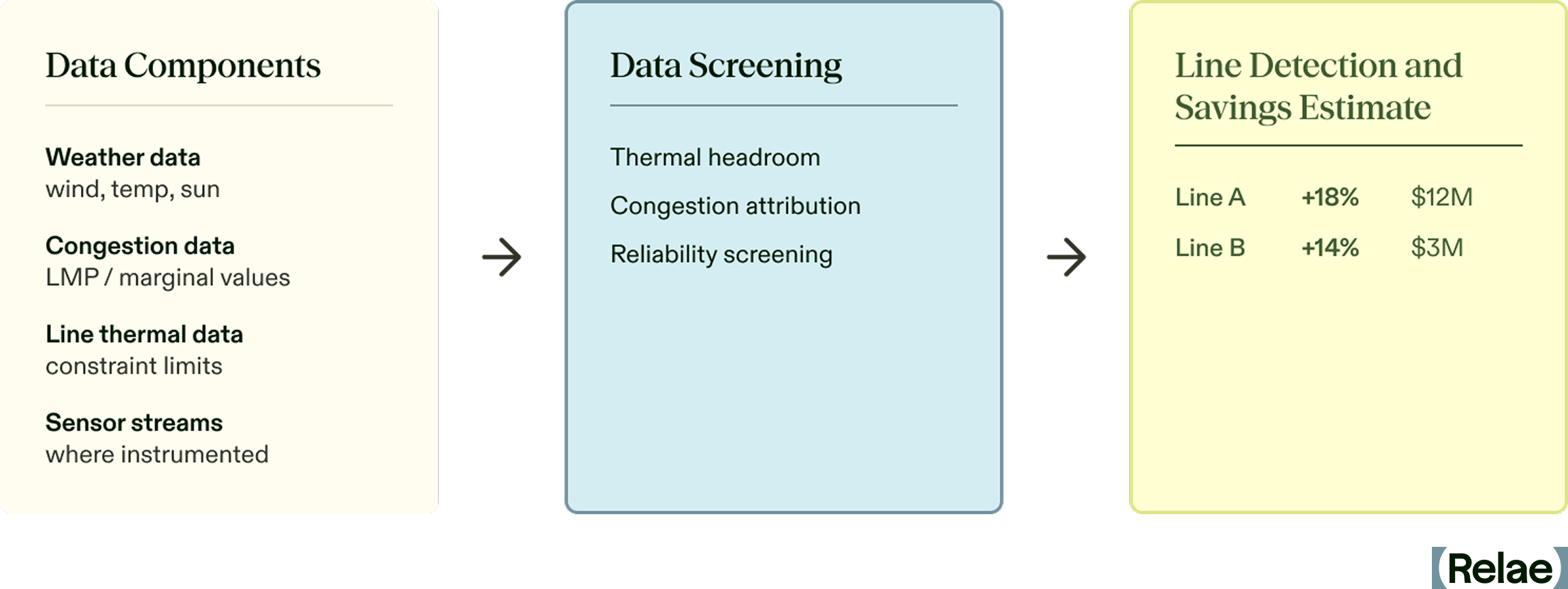
To illustrate the congestion savings from DLR, Relae screened PJM's five-minute real-time market record for every binding transmission constraint in 2025. For each one, we captured the shadow price, the marginal value of relaxing that constraint.3
Our analysis focused on thermal constraints, and then identified lines that bind frequently, in conditions milder than the worst case their static rating was set for, which is when a conductor's true rating sits above its static assumption. For the lines that we identified, congestion costs were added over the binding hours to set a bound on the savings that could result from DLR. That full amount would not necessarily be realized in practice, because the shadow price values only the next megawatt freed, and relieving one line can shift the constraint to the next. However, it serves as a useful estimate for the scale of savings that could be achieved.
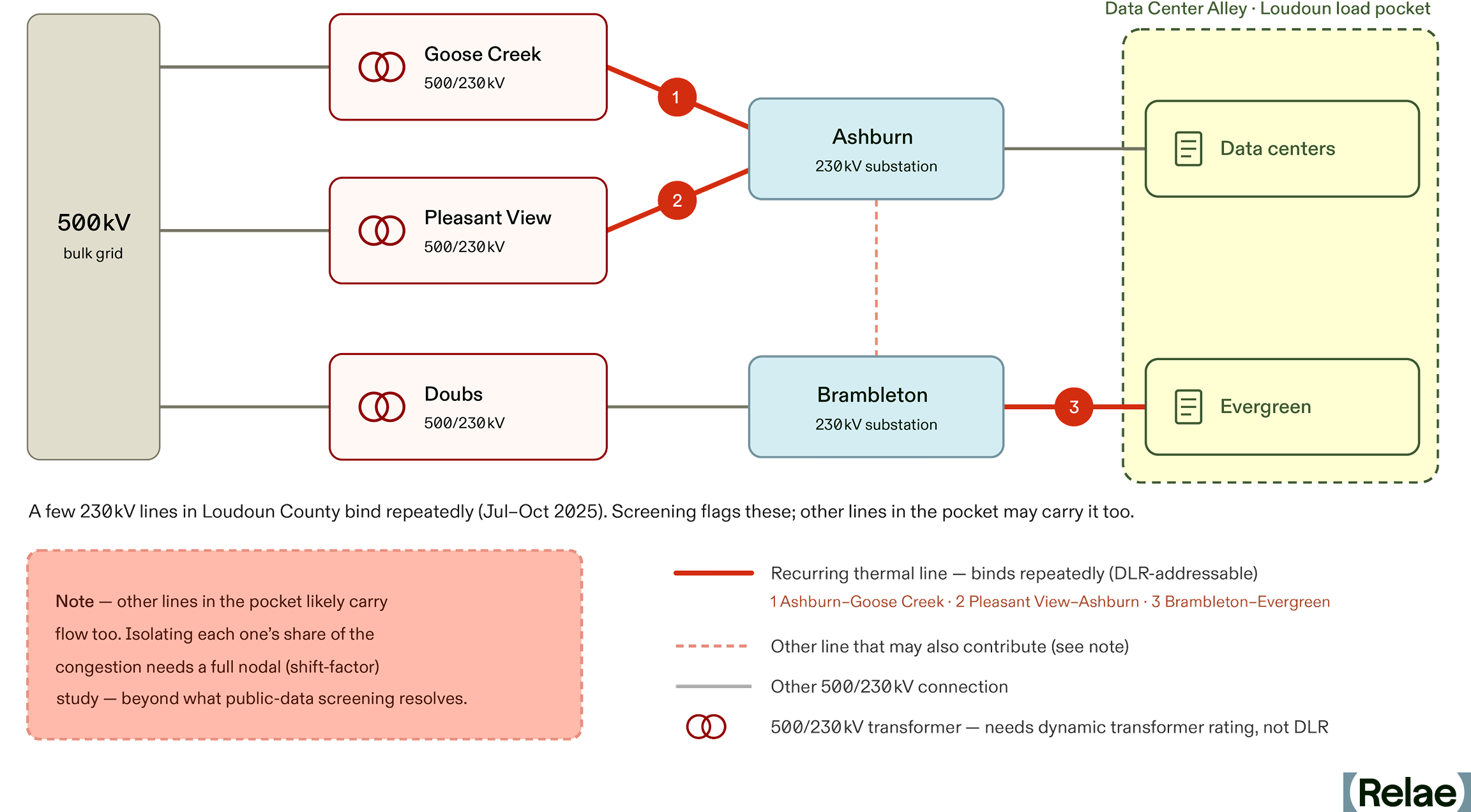
We ran the analysis on the Dominion (DOM) zone in PJM, home to Data Center Alley in Loudoun County, Virginia. Figure 2 shows a high-level section of the grid. The 500 kV bulk grid steps down through transformers to the 230 kV substations feeding the data centers, with the lines that experience recurring congestion highlighted. A handful of those 230 kV lines showed up as binding thermal constraints again and again.
The congestion in DOM isn't constant, and it concentrates in particular months and within the day in particular hours. Figure 3 shows three transmission lines within the DOM zone and the number of hours each was thermally congested in each hour-of-day slot over 2025. Binding concentrates in the warm months and, within the day, from late morning through early evening.
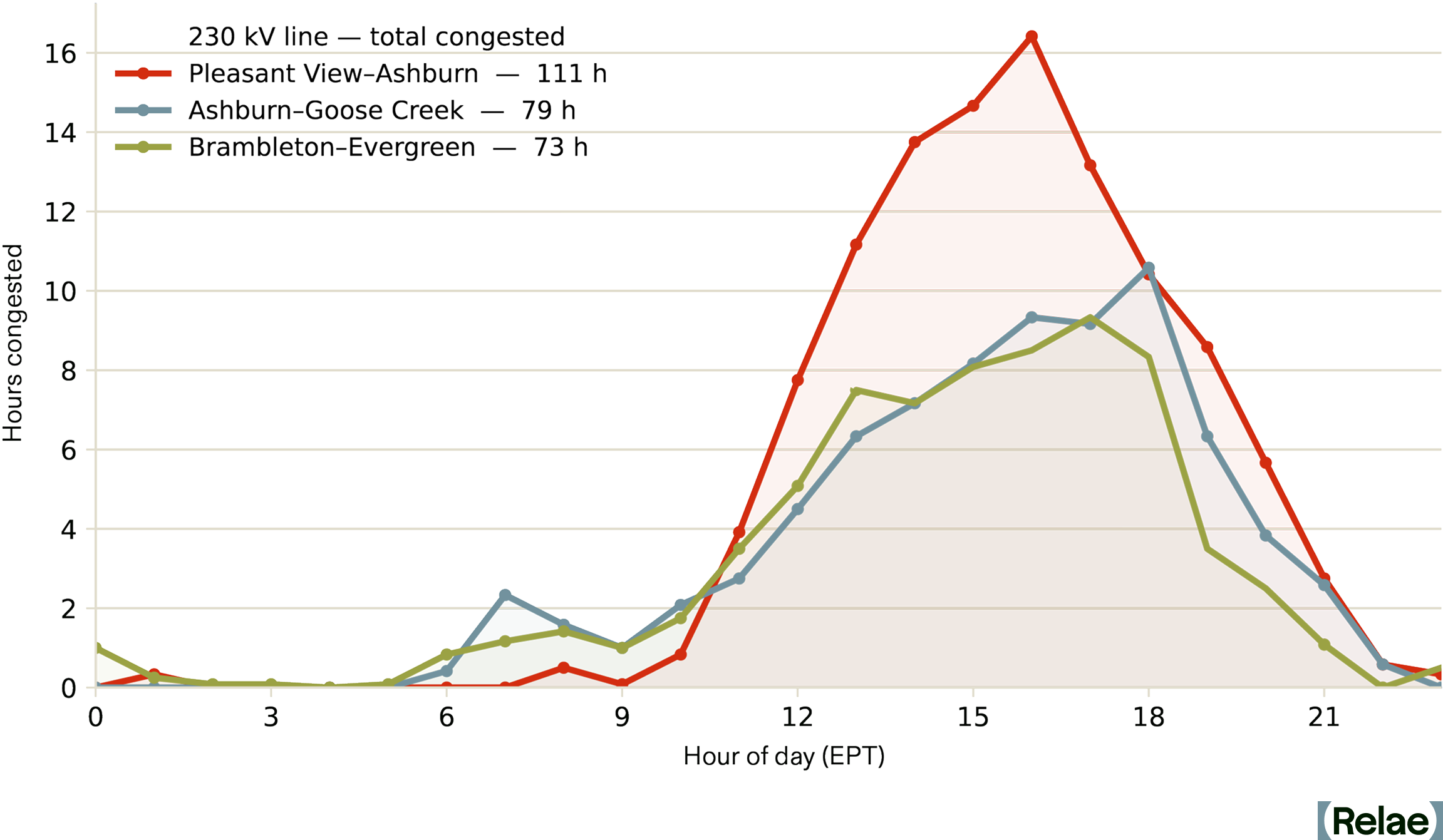
At first glance, this period looks like the wrong window for DLR. The local weather record says otherwise. These periods turn out to be some of the windiest hours of the day, not the stillest. Median wind speed at Dulles ran about 3.5 m/s, above the 0.6 m/s crossflow a static rating conventionally assumes, with fewer than 5% of observations falling below that threshold. Median ambient temperature in those hours was about 26°C, against the 35–40°C a static summer rating is typically built for. Across all three lines, the large majority of congested hours coincided with weather that would have supported a materially higher rating.
Valuing just one megawatt of DLR relief at each five-minute shadow price, the estimated savings are worth roughly $300,000 in this three-line example across about 263 line-hours.4
Because the value concentrates on a handful of thermally limited, heavily congested lines, and because the operational case has to be made line by line, capturing the opportunity is fundamentally an analytics problem: find the right lines, and prove the savings.

What Does It Take to Scale DLR?
DLR is cheap and effective, but two things stand between it and broader adoption: incentives and advanced grid analytics.
The utility cost-of-service model recovers investment in generation and transmission assets and earns its profit as a regulated return on the capital deployed. Because rates recover capital rather than power delivered, utilities have a stronger incentive to build or upgrade lines than to move more power across the ones they already own. That bias toward capital investment over optimization is why a mature technology has stayed niche in the US for years. Regulators have started to look more closely at this, but the main federal rule still mandates the milder AAR, not DLR, and leaves the return model untouched.
Contingency analysis compounds the problem. Current models are built around fixed line limits. A rating that changes hour to hour adds real modeling work, and more importantly, the system still has to hold under worst-case contingencies. So while operators already forecast weather daily for wind and solar, the harder step is trusting a forecast enough to commit a transmission limit against it. That takes significant predictive analytics built into system planning, not bolted on after.5
How Policy Is Starting to Shift the Calculus
Policy is starting to move the incentive problem. FERC's Order 881 made AAR the minimum for the transmission providers it regulates (effective July 2025, with several operators on extended timelines) and required markets to be capable of accepting dynamic ratings. PJM has started to implement this: PPL Electric has run sensor-based DLR on nine congested lines since 2022, feeding PJM's day-ahead markets.
Order 1920, FERC's first long-term transmission-planning overhaul in more than a decade, now requires planners to formally evaluate grid-enhancing technologies like DLR against conventional builds. It stops short of mandating deployment, but it forces a comparison utilities used to skip. That comparison is now written into filed tariff processes (PJM filed its plan in December 2025). Those first cycles only began in 2026, and the order allows up to three years to reach a selection, so the results are still pending.
A shared-savings incentive, letting a utility keep a slice of the congestion savings it creates, has been proposed to FERC and championed in the Advancing GETs Act, but it isn't yet a rule, so the core misalignment stands. DOE's GRIP program has funded grid-enhancing deployments, and by early 2026, 16 states had some form of advanced transmission technology requirement, with Colorado adding its Grid Optimization Act in April 2026.
The newest pressure is coming from the demand side. Through 2025–26, FERC began overhauling how large loads connect to the grid, and while none of it touches the utility's return on capital, it changes who sees the costs. FERC issued show-cause orders directing all six grid operators to justify or reform their large-load rules. This tees up consideration of alternative transmission technologies in study processes and greater transparency into costs.
And the rules are moving toward making the large load pay for the upgrades its connection requires. Pennsylvania's model large-load tariff, for example, recommends utilities charge data centers for the upgrades their interconnection makes necessary. It also instructs utilities to let those customers self-construct certain upgrades, including some affecting the wider grid. That combination is what matters. The party paying the bill now has a reason to ask whether a cheaper fix exists and, in at least one state, a route to build it. We have not yet seen a DLR deployment selected this way, because these frameworks are only months old, but the cost gap between a DLR fix and a rebuild is becoming visible to the party who pays the difference.
How Relae Helps Find the Value of DLR
Through our Power, Data, and Innovation practice, Relae combines transmission congestion data, line-level thermal constraints, and short-term weather forecasts into a single view of where dynamic ratings would actually pay. The output is a short list of candidate lines, each with a modeled capacity uplift and an estimated dollar value, turning a vague “DLR is promising” into a priced, line-by-line decision. It is the transmission-side complement to our work on the interconnection queue and demand-side flexibility. All three are ways of closing the gap between demand and delivered capacity faster than new construction allows.
The AI Bubble Debate Misses the Point: The Bottleneck Is Physical
Key Takeaways
- Agentic inference has changed the economics of AI. Tokens are becoming units of work and the economic driver is now the work produced, not token generation. Per-token costs are falling and the willingness to pay for work produced is rising; these two trends compound. This tailwind enhances AI economics and has spillover impacts on all layers of the AI stack.
- The AI infrastructure question has shifted from whether demand will show up to whether the physical stack can scale quickly enough. That stack includes power generation, grid capacity, interconnection, compute, memory, networking, cooling, siting, and community acceptance.
- Carbon Direct Capital and Relae (formerly Carbon Direct Inc.) have a differentiated view because the two entities work across both sides of the constraint: Relae advises hyperscalers and energy buyers on power and grid bottlenecks, while Carbon Direct Capital invests in the technologies that relieve those bottlenecks.
- Carbon Direct Capital sees better risk-adjusted returns investing in the physical foundations of AI, including clean firm power, energy system efficiency, data center efficiency, and inference-optimized compute, rather than chasing late-stage AI application valuations.
A Better Question Than "Is AI a Bubble?"
The most important development in AI economics is agentic AI turning tokens into work, a shift that reframes the bubble debate which dominated investor conversations, sell-side notes, and Chief Information Officer surveys through early 2026. Hyperscalers spent approximately US$380 billion on capital expenditure (capex) in 2025 and have guided to approximately US$720 billion of capex in 2026.¹ Carbon Direct Capital and Relae have worked together to build project-level models for both training and inference facilities to demystify the numbers and understand financial and technical sensitivities. The core finding was that the assets could be bankable using standard assumptions and that the binding constraints were physical, not financial. That conclusion has been reinforced in recent months by new developments.
Concretely, AI is moving from single prompts and answers to multi-step workflows that plan, reason, call tools, verify outputs, and keep state. This shift to inference is the structural successor to training in the initial AI capex cycle; it changes power requirements, time to power, and compute architectures all at once. Goldman Sachs estimates that agentic AI could drive a 24-fold increase, relative to a 2026 baseline, to roughly 120 quadrillion tokens per month globally by 2030 as per-token costs continue to fall. SemiAnalysis makes the same point from another angle: the value of frontier tokens has risen as agentic workflows become useful, while hardware and software improvements have reduced the cost of producing each token.
This does not mean every AI company is attractive, every data center project works, or every valuation is justified. It means the easy bubble framing is missing the more investable question. If token demand is compounding and the unit value of work produced is rising, the scarce resource is not abstract enthusiasm. It is the physical infrastructure required to turn that demand into work produced.
The Data Center Model Still Matters, But the Box is not a Black Box
Our internal modeling for an illustrative 167-megawatt inference data center using Nvidia Blackwell graphics processing unit (GPU) servers suggests the potential for high-teens percent equity returns under a defined set of assumptions.² We built a bottom-up underwriting, beginning with the number of users served per inference data center, assuming approximately how many tokens they will demand daily, and translating that token demand into compute needed based on industry-standard quantization and utilization rates. We then inferred the number of GPUs and servers needed to achieve the desired compute, which ultimately drove the total invested capital and power demand based on assumed thermal power designs and power usage effectiveness (PUE). On the revenue side, we used GPU-as-a-service rental rates as one proxy for the market value of compute capacity. A hyperscaler would not rent scarce compute externally if it had higher-value internal demand for that same capacity. As we will detail below, GPU rental prices have been steadily increasing on the back of inflecting inference demand.
This model is not the entire argument; it is the starting point. An important lesson is that power cost alone does not break data center economics. Electricity is slightly over 10% of total costs in our model: a 50% increase in power price reduces equity-level returns by less than 2%. Access to power, speed of interconnection, and equipment availability matter more. In other words, the economics of the model facility are workable, but only if the facility can be built and powered on the timeline customers need.
That is where most AI commentary remains too superficial. It treats the data center as a black box: capex goes in, tokens come out. That misses the bottlenecks inside and around the box. AI racks are moving far beyond traditional cloud power density. Cooling is shifting from air to liquid and two-phase systems. Networking and high-bandwidth memory become binding constraints in inference architectures. Grid interconnection queue wait times stretch to years. Communities can and do block projects. The technical, physical, and political constraints are increasingly the drivers of potential returns.
Inference Makes the Constraint Structural
While training is episodic, inference is recurring. A training run can be delayed, accelerated, or redesigned. Inference happens every time a user asks a question, a developer runs an agent, a business automates a workflow, or an application calls a model in the background. Agentic inference multiplies that load because one user action can become many model calls, validation loops, and memory reads; industry benchmarks show that agentic systems consume 5–30 times more tokens than a standard chat interaction.
Inference demand is also resilient in both directions. If efficiency gains lower the cost per token, more workflows become economic and total token consumption rises - the classic Jevons Paradox. However, token prices do not necessarily need to fall for inference spend to grow. As the economic unit shifts from tokens generated to work produced, customers may pay more per token when an agent delivers work produced that is worth more than the inference cost. Regardless of token price, tokens must all route through the same physical bottlenecks and we are seeing an increase in inference demand.
The architecture of inference is also changing. Some workloads will prioritize low-latency answers. Others, especially agentic work without a human waiting on every token, will prioritize memory, state, context, and cost per completed task. That means the AI infrastructure stack will become more heterogeneous, not less: XPUs (specialized AI accelerator chips), custom silicon, photonics, memory hierarchies, and edge or regional deployment models will all matter. The pricing data shows demand for more AI infrastructure overall: on-demand GPU rental capacity is effectively sold out across all chip generations in early 2026, with one-year Hopper H100 contract pricing rising 15–20% month-on-month through March 2026 and Blackwell B200 rental rates up 23% in March alone. When rental rates rise into a wave of new chip supply, supply is not catching up to demand.
Power Is Not One Constraint, It Is Several
Saying "AI is power constrained" is true, but not specific enough. The real problem has several layers. First, data centers need more electricity than many local grids can deliver on hyperscalers' timelines. Crucially, some grids can supply sufficient power but not continuously for 8,760 hours per year, conflicting with traditional assumptions about service reliability and leading to novel strategies around flexibility and intermittent self-supply. Second, the grid must be able to absorb large, fast-moving computational loads without creating reliability risks. Third, customers need energy procurement strategies that satisfy cost, reliability, climate, and public-acceptance requirements. Fourth, projects must get built in real communities, through real interconnection processes and real permitting fights. Power is not simply a commodity to purchase. It is an infrastructure development problem.
This is where Relae is directly relevant. Relae has assembled a team of scientific, engineering, and market experts to support a paying power and energy advisory practice serving hyperscalers, energy buyers, and power producers. Its work answers the questions customers are asking before the market prices them: how to get more capacity out of existing physical grid infrastructure; how to assess the costs and value of load flexibility through advanced modeling capabilities; how to make clean firm generation bankable; how to reduce data center energy intensity; how to validate "bring your own power" and "bring your own compute" structures; and how to build projects that communities will accept.
In the last twelve months alone, Relae has supported hyperscalers on bankability assessments for next-generation geothermal, scoped load-flexibility programs for multi-hundred-megawatt, single-customer sites, and modeled the carbon and reliability profile of "bring your own power" configurations against grid-tied baselines. Carbon Direct Capital leverages our network of technical experts at Relae, including power engineers, geologists, and electrochemists, to conduct credible technical diligence and to gain insights into early stage market trends and emerging preferences.
What Carbon Direct Capital Is Investing Behind
Our investment focus follows the bottlenecks. On the power side, we are investing in technologies that can deliver reliable power on AI timelines. Sage Geosystems is a next-generation geothermal platform with hyperscaler buy-in; Carbon Direct Capital co-led its US$97 million Series B with Ormat Technologies. We could not have made this investment without the deep expertise of the Relae research team which analyzed Sage's technical results to date to help underwrite future project feasibility. ION Clean Energy is a company that retrofits carbon capture technology onto natural gas combined cycle plants to create "blue electrons"; Relae is in active dialogue with multiple large power users on this topic. Carbon Direct Capital is also actively evaluating the enabling picks and shovels around geothermal, nuclear, fuel cells, and more.
On the data center efficiency side, we are investing in technologies that reduce the amount of power required for a unit of AI work. While it is encouraging to see incremental annual gains in chip efficiency, these are scaling far more slowly than compute demand, driving the need for more innovative technological solutions. As one example, a team at Relae helped us understand the fundamental energy consumption requirements of a standard complementary metal-oxide-semiconductor (CMOS) chip, and the potential of all-optical computing as an alternative. This led to Carbon Direct Capital investing in Neurophos, a photonic compute company targeting step-function gains in energy efficiency per chip that are beyond those achievable by existing GPUs. Carbon Direct Capital joined the company's US$110 million Series A alongside Gates Frontier, Microsoft's M12, Aramco Ventures, Bosch Ventures, and others. More broadly, we are studying other layers of the data center technology stack including networking, memory, cooling, and inference-optimized architectures because the next phase of AI infrastructure will not be solved by simply buying more of yesterday's hardware.
The Bear Case Deserves to Be Taken Seriously
There are real risks to the AI boom: Hyperscaler free cash flow can compress if capex grows faster than revenue. Model efficiency gains can reduce the amount of compute required for a given task. Training demand may be more episodic than the market assumes. Local opposition can slow or cancel data center and power projects. Some new data center capacity could become expensive cloud infrastructure competing on price if AI revenue disappoints.
Those risks are why Carbon Direct Capital frames this as an investment in constraints, not in AI enthusiasm. If efficiency improves, inference use cases expand and the bottleneck shifts to deployment, memory, power, and cost per unit of work produced. If training demand slows, inference and enterprise agents still require recurring capacity. If local grids cannot absorb load, technologies that unlock power, reduce energy intensity, or improve flexibility become more valuable. If some AI applications or model developers fail, the upstream physical bottlenecks remain for the rest.
The Investment Conclusion
The AI infrastructure opportunity sits at the intersection of frontier technology risk, project-finance economics, and energy-system engineering. Underwriting this opportunity well requires addressing all three at once; Carbon Direct Capital is built to do just that. The technical team at Relae has a pulse on emerging stakeholder preferences and scientific breakthroughs, understands novel technologies deeply, and is highly experienced in conducting detailed technical diligence to ensure that projects are viable and scalable. Carbon Direct Capital combines these market and technical insights with our commercial underwriting to facilitate new investments. We are not picking AI winners. We are not picking pure energy assets. We are investing in the companies and technologies that have to exist for AI to sustainably scale.
Frequently Asked Questions
Is the AI capex boom a bubble? While valuations vary, token demand and physical infrastructure needs are real and compounding. The correct question to ask is not whether AI is a bubble, but what the binding constraints are. Our modeling shows that constraints are physical, not financial.
What are the real constraints on AI infrastructure growth right now? AI infrastructure growth is constrained by power availability, grid capacity, and interconnection speed, not capital availability.
Why does inference matter more than training for long-term AI power demand? Inference is recurring and grows with AI usage, it is not episodic like training runs.
What is Carbon Direct Capital investing in, and why? We are investing in clean firm power, energy system efficiency, data center efficiency, and inference-optimized compute—the physical bottlenecks rather than application-layer valuations.
Disclaimer
Carbon Direct Capital Management LLC is an investment adviser registered with the US Securities and Exchange Commission (SEC). Registration as an investment adviser does not imply any particular level of skill or training. Additional information about Carbon Direct Capital Management LLC, including our Form ADV Part 2A Brochure, is available on the SEC's website at adviserinfo.sec.gov.
This content is provided for informational purposes only and should not be construed as or relied upon as investment, legal, tax, or other advice. You should consult your own advisers regarding legal, business, tax, and other matters related to any investment. Any projections, estimates, forecasts, targets, prospects, or opinions expressed are subject to change without notice and may differ from opinions expressed by other employees of Carbon Direct Capital Management LLC, its affiliates, investors, portfolio companies and other individuals, groups or entities. Certain information contained herein may have been obtained from third-party sources believed to be reliable; however, Carbon Direct Capital Management LLC makes no representations about the accuracy or completeness of any such information or its appropriateness for any given situation. Any investments or portfolio companies mentioned are not representative of all investments made by funds managed by Carbon Direct Capital Management LLC, and there can be no assurance that any investment will be profitable or that future investments will have similar characteristics or results. Past performance is not indicative of future results. The content speaks only as of the date indicated. This content does not constitute an offer to sell or a solicitation of an offer to buy any security. Any such offering will be made only pursuant to formal offering documents.
Understanding the Carbon Footprint of AI and How to Reduce It
Key Takeaways
- AI's carbon footprint has two distinct parts: embodied emissions from building data centers and operational emissions from running them, both accelerating as global data center electricity use is set to double by 2030, and AI-focused use to triple.
- Managing that footprint will require deliberately steering technology architecture, power sourcing, and materials choices, instead of leaving them to react to demand after the fact.
- Eight concrete strategies, from smarter chip design to firm clean power and carbon removal, can cut AI's footprint today, without waiting on new regulation.
- US data centers used 4% of the USA's total electricity in 2024, and are projected to use as much as 15% by 2030.
Introduction
The rapid growth of artificial intelligence (AI), particularly large-language models (LLM) and generative AI, has taken many by surprise. This surge has led to escalating electricity demands at data centers and raised concerns about the strain on the power grid. It has also sparked the construction of new, larger data centers, resulting in growing embodied emissions tied to building and maintaining AI physical infrastructure.
Managing the risks of increased greenhouse gas (GHG) emissions from AI requires investment, expertise, and new approaches to building and operating many aspects of AI operation and supply chains. The immediate task is to understand these risks, gather the necessary information, and to avoid poor outcomes by proactively managing construction, operation, and emissions associated with the growth in AI. In parallel to that work, it's important to recognize that AI can itself be a real force to reduce emissions incrementally and dramatically across a wide range of sectors.
What Is the Carbon Footprint of AI?
The carbon footprint of AI consists of two main parts: "embodied" emissions that come from manufacturing IT equipment and constructing data centers, and "operational" emissions that come from electricity consumed by servers, memory and networking equipment as they perform AI-related calculations. Both of these aspects of emissions are growing as more data centers are built and existing data centers increase their share of power-hungry AI applications like generative LLM searches, AI agents, and AI image generation.
Understanding Electricity Demand for Data Centers
Today, the electricity demand from AI-specific applications is estimated to be less than 1% of global electricity use. To understand this number, it helps to start with the electricity consumed by the 12,000+ data centers worldwide, which was about 1.5% of global electricity consumption in 2024. (This excludes another 0.4% from cryptocurrency mining.) However, most of the computation at these data centers is not AI; instead, it's more conventional applications like e-commerce, video streaming, social media, and online gaming.
The amount of AI-based computation at data centers is hard to determine, but AI-dedicated accelerated servers consumed about one third of overall data center electricity in 2025, or roughly 0.5% of global electricity. Notably, this is projected to grow at 30% annually, much faster than conventional (non-AI) data center electricity use. However, that electricity use results in a relatively small share of greenhouse gas emissions: about 0.5% of global fuel combustion emissions, with AI data centers representing only a small portion of that value.
Still, the demand for AI applications is rapidly growing, and this is likely to drive up the electricity used by data centers and the associated greenhouse gas emissions. The most important implications of this trend are in the US, which hosts about half the world's data centers. Currently, data centers use about 4% of US electricity, but projections for the future range from a low of 9.5% to a high of 15.3% in 2030.
[cta]
How Electricity Sources Impact Data Center Emissions
A large increase in electricity use doesn't necessarily result in a similarly large increase in greenhouse gas emissions. Currently, a significant portion of the electricity powering data centers comes from zero-carbon sources such as wind and solar. This is partly because of large, corporate power-purchase agreements (PPAs) signed by leading data center operators, particularly Amazon, Meta and Google.
US technology companies have been buying renewable energy for years. Global corporate clean energy procurement hit a record 62 GW in 2024, then fell to 55.9 GW in 2025, the first annual decline in nearly a decade, as elevated power prices and policy uncertainty made even large buyers more selective. Meta, Amazon, Google, and Microsoft still accounted for roughly 49% of global clean energy procurement in 2025, with Meta and Amazon alone securing 20.4 GW combined, including 4.7 GW of nuclear power.
The use of low-carbon power means that the net emissions from these data centers is smaller than the electricity consumption numbers might suggest. Of course, a crucial consideration is whether this low-carbon power is truly "additional," meaning that it is being added to the grid and not simply taken away from other uses. Data center operators are also expanding beyond their traditional wind and solar PPAs by exploring novel approaches to try to meet this standard, including geothermal projects in the US and Taiwan.
However, the projected electricity demand from AI applications at data centers will be difficult to meet entirely with low-carbon power, at least in the near term. Despite installing over 43.2 GW of wind, solar and battery projects in the US in 2025, these generators face a long wait for interconnection approval in many parts of the country. Geothermal and hydro power, which offer steady ("baseload") low-carbon electricity, remain constrained in the near term. And the interest in scaling up nuclear power, from restarting full-scale reactors to novel small modular reactors (SMRs), faces significant regulatory, cost, and supply chain hurdles.
One important source of low-carbon electricity that has not received enough attention is natural gas-fired power equipped with carbon capture and storage (CCS). This technology has the potential to significantly reduce emissions from existing power plants and enable new projects to achieve near-zero emissions.
The Role of Embodied Emissions in Data Center Construction
Embodied emissions include all emissions associated with the extraction, production, transportation, construction, and disposal of materials used in construction.
The embodied emissions from constructing data centers are substantial, and include concrete, steel, and IT hardware. Scope 3 GHG emissions for data centers—which include embodied emissions—range from approximately one-third to two-thirds of overall lifetime emissions. At Microsoft, Scope 3 emissions made up about 86% of the company's total FY2025 footprint and grew roughly 12% year over year, with capital goods driving most of that increase. In FY2024, capital goods alone accounted for about 41% of Microsoft's Scope 3 emissions, and purchased goods and services (including IT hardware) accounted for another 34%. In response, Microsoft has started using wood in some data center construction to reduce this impact. While using wood offers a partial solution, it cannot fully offset the emissions of even a single facility, and wood supply chains remain limited.
Major data center operators are working hard to address this challenge, including emphasizing the need for standardized emissions measurements and disclosures for key building materials. Ultimately, achieving deeper decarbonization will require further action to address both operational and embodied emissions.
Eight Strategies to Reduce the Carbon Footprint of AI
1. Adapt Technology Architecture
Efficiency is the foundational strategy in any clean energy approach. As such, chipmakers are developing ways to cut energy use from the outset, such as incorporating more memory directly onto computer chips or hard-wiring basic calculations. These innovations have already reduced energy consumption in new computer chips substantially, in some cases a 96% improvement. Examples of this include NVIDIA's Blackwell platform and the company's newer Rubin platform, launched in 2026, continues that trajectory. Likewise, servers are being designed with new architectures that minimize internal data transfers, delivering additional efficiencies. Even more efficiency gains may be possible with emerging technologies like photonic computing.
2. Optimize Training Geography
There are also significant opportunities to manage AI's energy use through time and space optimization. For example, a large portion of the energy consumption for LLMs occurs during the training phase, prior to a model's deployment for inference. Because these training tasks are not location-dependent, they can be carried out in regions with abundant, low-cost, low-carbon electricity, as part of broader efforts to dynamically move computing tasks to reduce emissions, known as carbon-aware computing. Additionally, server requests for generative AI tasks, like ChatGPT searches, can potentially be routed through systems powered by low-carbon electricity. Although this may add only a few milliseconds of latency, it could substantially reduce emissions from computing operations.
3. Select Appropriately-Sized Models
Not all generative AI tasks, like ChatGPT queries, are equal in terms of energy demand. Leading AI companies are increasingly focusing on using smaller, more efficient AI models to perform these tasks, achieving nearly equivalent quality for far less energy consumption. A notable recent test of that idea came in January 2025, when China's DeepSeek released a model with competitive performance that was trained using less powerful chips and far fewer computing hours than its established rivals. Similarly, many AI applications, such as digital twinning and satellite-based pattern recognition, consume far less electricity than generative LLMs, because of their specialized, relatively efficient models. This can even save energy compared to non-AI approaches: for example, some of the most advanced AI-driven weather prediction models require far less energy than traditional weather simulations, running on a laptop rather than a supercomputer.
4. Address Fugitive Methane Emissions
As data center operators increasingly plan on using natural gas for new electricity supply, reducing upstream emissions from gas production and transmission will be crucial. In the U.S., the Environmental Protection Agency (EPA) 2024 Methane Rule was designed to cut these non-carbon dioxide greenhouse gas emissions by approximately 80%. However, Congress repealed the rule's methane fee in 2025 and barred the EPA from collecting it until 2034. The EPA has since extended compliance deadlines and loosened flare and vent-gas requirements, with litigation over those changes still ongoing. Meanwhile, tools from companies like Kayrros and organizations like Carbon Mapper help detect methane leaks and attribute them to specific operators. The best actors in the industry emit minimal methane, less than 0.5% of what is produced. This standard is achievable for nearly all gas producers.
5. Use Carbon Capture on Power Plants
For both new and existing natural gas-fired power plants, carbon capture and storage technology offers the potential for generating firm, low-carbon power. While many plants currently in operation continue to emit unchecked, this doesn't have to be the case: their emissions can be captured and securely stored geologically. Hyperscalers and project developers should pursue new investments and business models for CCS to reduce existing emissions by 95% or more. For new generation projects, options like NetPower, Arbor, and CES will soon enable emissions abatement of 100%, or even more if combined with biopower to deliver carbon dioxide removal as well. Achieving this will require the development of carbon dioxide pipelines, barges, and storage facilities, which face their own challenges, such as permitting and community approval, that must be addressed directly.
6. Add More Zero-Carbon Power to the Grid
Roughly 8,200 solar, wind, and battery projects in the U.S. are seeking grid interconnection. By the end of 2025, the interconnection queue held roughly 2,060 GW of proposed generation and storage across thousands of projects, and its composition shifted meaningfully. Solar, wind, and storage volumes in the queue all declined year over year (although remained at high absolute levels) while natural gas capacity in the queue grew by 86%. Our blog post, The $5.5 Billion-Dollar Case for Enabling Data Center Load Flexibility, covers one way hyperscalers are working around the wait rather than simply enduring it. These delays need to be addressed, and permitting reform remains an unresolved, live debate. The Manchin-Barrasso bill, which once looked likely to pass, was tabled in December 2024 and never became law. As of 2026, no comprehensive federal permitting law has replaced it. One potential innovation is to use AI to accelerate the development of power flow models and streamline the paperwork required to complete the regulatory process.
7. Invest in Low-Carbon Building Materials
While wood is a promising low-carbon building material, we'll also need glass, concrete, steel, aluminum, and computer chips with minimal embodied carbon emissions. Hyperscalers currently face significant challenges accessing low-carbon versions of these materials, which will eventually be produced using low-carbon hydrogen, carbon capture and storage, and low-carbon electricity. However, these systems require significant investment, workforce development, and permitting to be built. Without these advancements, the embodied emissions from data centers will increase rapidly and significantly in the US, Europe, and globally.
8. Increase Carbon Dioxide Removals
It's already clear that AI applications at data centers will generate emissions from electricity use and embodied carbon that cannot be avoided in the near term. Estimates of current greenhouse gas emissions exceed 300 million tons per year and are likely to grow this decade. These emissions should be measured using full life-cycle analysis and then offset through high-quality carbon removal projects, preferably those with high durability.
To effectively reduce the environmental impact of AI, all eight strategies discussed must prioritize the communities most affected: frontline communities near new infrastructure, consumers facing price increases, and tribal authorities with limited legal protections. Our own research on community opposition to AI data centers found that transparency, not cost or environmental impact alone, is the dominant driver of pushback across 46 stalled or blocked projects. We explore this concern further in our blog, Who Pays for the AI? The Hidden Costs of Rising Data Center Demand, including how ratepayers, not just data center operators, often absorb the cost of new grid infrastructure. Planning should begin by understanding the needs of these communities, ensuring that efforts focus on minimizing harm while maximizing benefits. Equity and justice must be embedded in every stage of planning, production, and permitting across all strategies.
AI's Power Demand Is Indicative of Broader Electricity Demand
AI is just one part of a broader trend of rapidly growing electricity demands, including from electric vehicles, heat pumps, industrial electrification, green hydrogen, and various e-fuels. The challenges AI presents to hyperscalers, communities, regulators, and investors serve as a preview of the complex, far-reaching impacts emerging in other sectors. The same questions keep recurring. Who secures reliable, affordable power fast enough? Who ends up carrying the cost and emissions burden of getting there the wrong way?
Managing AI's power demand will require building the technology architecture, clean firm power supply, and materials strategy to meet that demand deliberately, rather than reactively. AI's carbon footprint underscores the critical need for expertise in clean electricity, grid management, decarbonization, and carbon removal—expertise that will become increasingly vital as more companies realize the complexity and cost of the journey ahead.
Fortunately, AI itself can be part of the solution. With applications in grid management, material science, and advanced manufacturing, AI has the potential to play a powerful role in the climate response.
Read the full 2025 report: ICEF Sustainable Data Centers.
Frequently Asked Questions
How much electricity do AI data centers actually use?
AI-specific computation likely accounts for around 0.04% of global electricity use today, but data centers overall (most of it non-AI computation) used about 1.5% of global electricity in 2024. In the US, which hosts roughly half the world's data centers, Lawrence Berkeley National Laboratory puts current usage at 4% of US electricity, projected to reach 9.5-15.3% by 2030 as AI-specific demand grows.
Will more efficient AI models like DeepSeek reduce data center energy demand?
Not necessarily. DeepSeek's 2025 debut showed that competitive models can be trained with less powerful chips and fewer computing hours, but whether that translates into lower total energy demand is contested. Historically, efficiency gains in computing have tended to get absorbed by increased usage rather than reducing total consumption, so the honest answer is that it depends on whether demand growth outpaces the efficiency gained.
What is being done about the embodied emissions from building AI data centers?
Embodied emissions, from concrete, steel, and IT hardware, can account for one-third to two-thirds of a data center's lifetime emissions. Strategies include using lower-carbon materials like wood where feasible, developing low-carbon concrete, steel, and chips, and standardizing emissions disclosures for building materials so operators can compare and choose lower-footprint options.
Inside NERC’s Level 3 Alert on Data Center Loads
Key Takeaways
- On May 4, 2026, the North American Electric Reliability Corporation (NERC) issued a rare Level 3 “Essential Actions” Alert in response to repeated events in which 1,000+ megawatts (MW) of computation load dropped off the bulk power system in seconds, leading to major grid stability issues.
- The pattern has since escalated: on July 22, 2026, a transmission fault in Ashburn, Virginia took more than 3 GW of data center load offline in seconds—roughly 3% of PJM demand at the time.
- NERC also published Reliability Guidelines that push the same concerns into long-term planning, explicitly recommending resource adequacy models that capture firm vs. flexible load, behind-the-meter resources, and AI training operating windows.
- For transmission operators and balancing authorities, the releases compel new scrutiny of how computational loads affect stability and resource adequacy. For hyperscalers and other large loads, those assessments now sit on the critical path: if operators cannot show through advanced modeling that they can integrate the new loads, interconnection and buildout plans stall.
- Meeting the bar takes advanced grid modeling at multiple time and spatial scales, from sub-second stability through long-horizon capacity and resource adequacy, to evaluate the role of large load portfolios considering demand response, storage, and co-located generation.
Why Grid Frequency Matters for Large Loads
When we turn on the lights or charge our phones, it’s easy to forget that electricity travels through the power grid as alternating current. Sixty times a second—far faster than our eyes can see—the flow of electricity alternates back and forth along the wires making up both the transmission and distribution parts of the North American grid.
Power generation equipment and most large industrial loads are designed to work with this 60 Hertz (Hz) alternating flow and must be synchronized precisely to this rhythm to function. Grid synchronization is so important that it can even have geopolitical implications.
For some electrical equipment, getting out of sync with the grid’s frequency can lead to malfunctions or even physical damage and destruction. That’s why grid-connected equipment is protected by circuits that automatically disconnect from the grid (“trip offline”) if the grid frequency begins to deviate by even one percent. For minor equipment, this is easily managed. However, when large amounts of generation or load trip offline quickly, it can lead to rapidly cascading grid blackouts affecting tens of millions of people with costs in the billions.
Grid operators pay extremely careful attention to factors that could cause grid frequency to deviate. The grid’s frequency stays near 60 Hz only when total power generation and consumption (load) are closely balanced. If load suddenly drops below generation, physical rotating generators like gas turbines can begin to speed up, making grid frequency rise.
This becomes particularly dangerous when large grid-connected loads all trip offline simultaneously because of minor frequency deviations or other factors. If these loads are large enough, they can trigger a cascading sequence of rising frequency and further equipment and generator trips, potentially causing a complete “grid collapse” blackout. The North American grid may be getting closer to this scenario.
What Triggered NERC’s Highest-Urgency Alert
Data center load drops are now a documented grid stability threat. On May 4, 2026, NERC issued a rare Level 3 “Essential Actions” Alert—its highest-urgency notification—in response to a pattern of customer-initiated load reductions in which 1,000+ MW of computational load (data centers) dropped off the bulk power system (tripped offline) in seconds. These were “customer-initiated” because protection circuits at data centers detected problems with grid-supplied power and automatically disconnected to protect their sensitive computing equipment from electrical damage.
Paired with a new Reliability Guideline on emerging large loads, the alert highlights the urgent need to better understand the potential for these events to cause grid instability or even blackouts. Together, these two documents reset the bar for the detailed grid modeling and planning needed for any utility, independent system operator (ISO), or hyperscaler with material data-center growth in its footprint.
Customer-Initiated Load Reductions
A customer-initiated load reduction (CILR) is an event in which a large load, most often a data center, AI training facility, or crypto miner, abruptly and without warning reduces or disconnects its electricity draw from the grid in response to a frequency or voltage disturbance that the grid’s internal protection circuits interpret as unsafe.
Compute-based loads like AI data centers are particularly sensitive to changes in the expected voltage and frequency from grid-supplied power, and their automated electrical protection systems tend to react more quickly and at smaller deviations than conventional industrial, commercial, and residential loads.
NERC has documented multiple events of 1,000+ MW since 2022, with reductions occurring in seconds, much faster than real-time operators can respond. This makes these events a significant risk to grid frequency stability that is distinct from more traditional load loss events that occur at a smaller scale or over slower timescales, allowing grid operators to take action to compensate.
How the Alert Reshapes Grid Interconnection
For utilities and ISOs, the alert and guideline raise the standard of evidence required to connect computational loads safely to the grid. Modeling assessments now sit on the critical path for large load interconnection decisions, and the same studies will increasingly inform reserve margin, transmission, and dispatch program designs.
For hyperscalers and other large loads, the consequence is direct. Plans that assume firm service without supporting analysis will face longer queues and tougher interconnection conditions. Buildout timelines now depend on whether utilities and ISOs can show, through stability and resource adequacy modeling, that the system can absorb the load and respond safely to its disturbances.
For storage developers, particularly long-duration and fast-responding assets, these events elevate the reliability value of rapid response and load-shifting resources. The same grid modeling improvements that capture flexible load behavior also surface storage's full reliability contribution.
For flexibility platforms, the same modeling work that satisfies NERC's expectations unlocks faster, cheaper interconnection. Demand response, large-load shifting, and co-located dispatch coordination are now both technical and commercial enablers.
A Higher Bar for Power Analysis
These pressures point to a higher bar for power analysis at multiple time and spatial scales, for utilities and the large loads they serve.
At sub-second to second timescales, electromagnetic transient (EMT) models capture fast electrical switching and the uninterruptible power supply behavior that determines whether a data center stays connected during a disturbance (“rides through”). The alert asks for these models to be more detailed, validated against actual equipment, and shared between large loads, transmission owners, and planners.
At seconds-to-minutes, dynamic stability simulation covers system frequency response, voltage recovery, and oscillation behavior after disturbances. NERC now expects annual stability studies and explicit load drop contingencies in planning files.
At hours-to-years, capacity expansion and production cost modeling determine whether the system has enough resources, in the right places, with the right flexibility, to keep up with computational load growth. NERC’s May 2026 Large Loads Reliability Guideline is most explicit at this scale, calling for resource adequacy studies that represent firm and flexible load components, behind-the-meter resources, AI training operating windows, and probabilistic scenarios across many weather, load, and outage combinations on a network-aware footprint.
Rising to the Challenge
Since the alert was issued, its expectations have begun hardening into rules. Registered entities were required to report to NERC on their progress against the seven Essential Actions by August 3, 2026, and on July 16, 2026, FERC directed NERC to go further: to develop mandatory reliability standards for computational loads and revise its registration criteria, with the first standards and Rules of Procedure changes due December 31, 2026 and a second-phase work plan due March 1, 2027. NERC's Large Loads Action Plan anticipates new "Computational Load Owner" and "Computational Load Operator" registered entity types alongside the first three computational load standards.
The practical consequence is that the modeling described above is no longer only good planning practice: utilities, ISOs, hyperscalers, and other large loads should expect the data-sharing, study, and commissioning expectations in the alert to return as auditable requirements, and should build the capability before the compliance deadline rather than after it.
Frequently Asked Questions
What is a NERC Level 3 Alert, and what does it require?
A Level 3 “Essential Actions” Alert is the most urgent of NERC's three alert levels, reserved for risks that need immediate, documented industry response. The May 4, 2026 alert directed registered entities to take seven essential actions on computational load—covering modeling, system studies, commissioning, protection, fault recording, and direct operational communication with large load operators. Written responses were due to NERC by August 3, 2026.
Why do data centers disconnect from the grid during minor disturbances?
Data centers run voltage- and frequency-sensitive computing equipment protected by automatic transfer systems that switch to on-site UPS or backup generation the moment grid power looks abnormal. Those protection settings trip faster, and at smaller deviations, than conventional industrial loads, so a fault lasting milliseconds can move a gigawatt of demand off the system in seconds. Because the shift is customer-initiated, grid operators get no warning and no time to rebalance.
How does the alert change interconnection for hyperscalers and other large loads?
Modeling assessments now sit on the critical path for large load interconnection. A plan that assumes firm service without stability and resource adequacy analysis behind it will face longer queues and tougher interconnection conditions, because the utility or ISO has to be able to show the system can absorb the load and respond safely to its disturbances. In practice, buildout timelines are now tied to someone else's study queue.
What modeling do utilities and large loads need to meet NERC's expectations?
Electromagnetic transient (EMT) models validated against actual equipment for sub-second ride-through behavior; dynamic stability simulation with explicit load-drop contingencies for seconds-to-minutes frequency and voltage response; and capacity expansion and probabilistic resource adequacy modeling that separates firm from flexible load, represents behind-the-meter resources, and reflects AI training operating windows. The paired Reliability Guideline is most explicit about the last of these.
Reconciliation Bill Dramatically Shifts the Clean Energy Landscape
Key Takeaways
- Accelerated phase-out schedules for key clean energy and decarbonization tax credits will shorten the runway for project development, which could stall or cancel projects.
- Urgency is paramount, and qualified projects should expedite construction and operational timelines to secure eligibility for existing credits.
- A more complicated policy landscape requires concerted effort to navigate, including with the support of policy professionals.
Reconciliation Rolls Back Much of the IRA
On Friday, July 4, 2025, the President signed a sweeping reconciliation bill, H.R. 1, that will add at least $3.3 trillion to the national debt and marks a pivotal, contentious moment for US clean energy policy. The law was enacted through the complex legislative process known as budget reconciliation, requiring only a simple majority of votes in the House and Senate. The new law substantially modifies or terminates many of the Inflation Reduction Act of 2022 (IRA)'s clean energy incentives and has extensive implications for the economic viability of American energy and manufacturing projects.
In the Senate, three Republicans crossed party lines to vote against the bill, requiring Vice President JD Vance to break the tie. In the House, only two Republicans broke ranks to vote against final passage. While some of the more complex provisions of the bill, such as new foreign entity of concern (FEOC) restrictions, will require more time to fully assess, we've prepared a rapid run-down of key alterations to IRA incentives for carbon management, hydrogen, and clean fuel technologies.
What Is the 2025 Reconciliation Bill?
While the 2025 reconciliation bill is staggering in length, scope, and severity, containing provisions to cut Medicaid, reduce nutrition assistance, raise the debt limit, and cut taxes primarily for the wealthy, some of the most drastic sections of the bill modify tax incentives and other public funding for clean energy and emissions reductions.
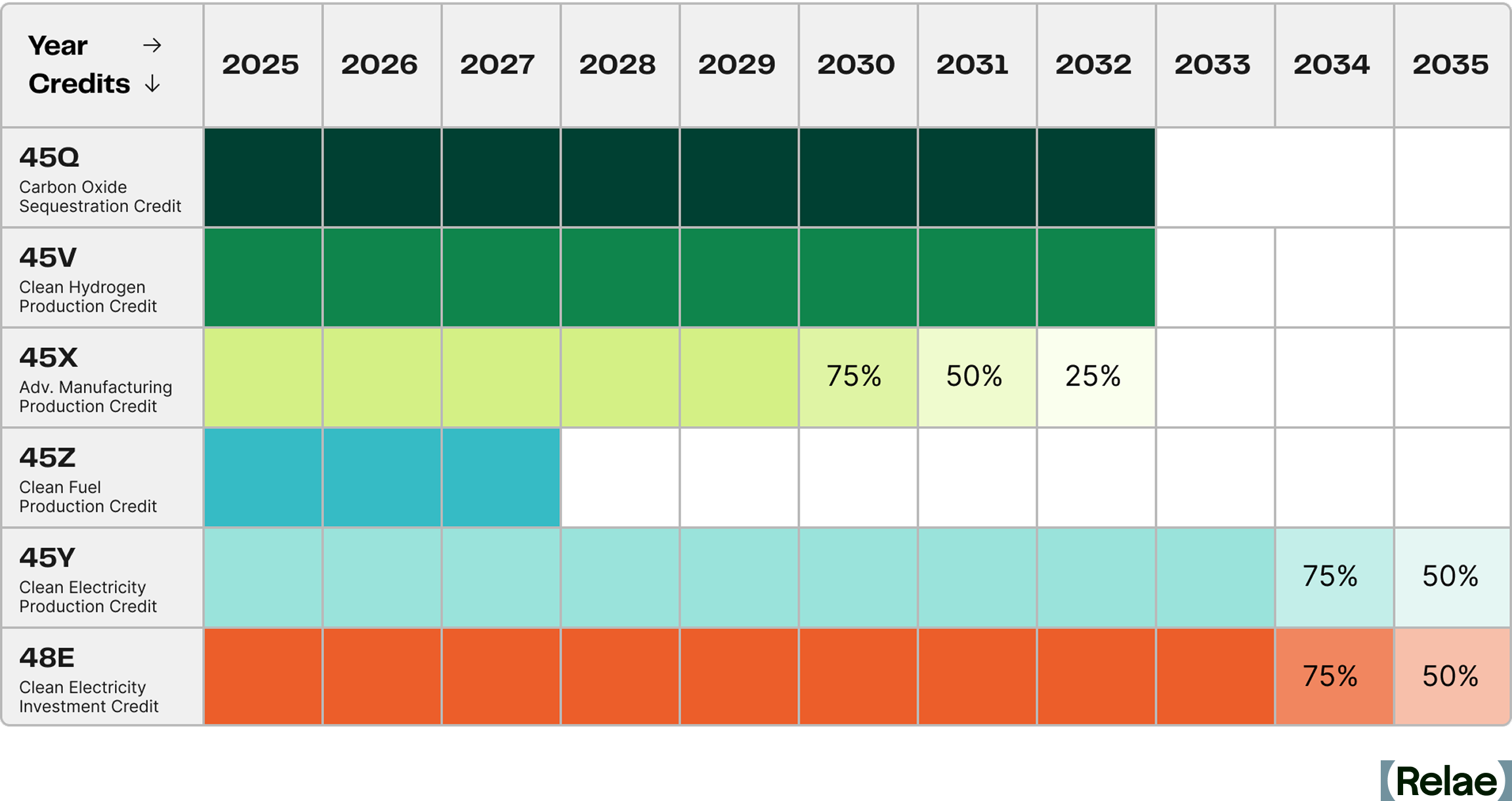
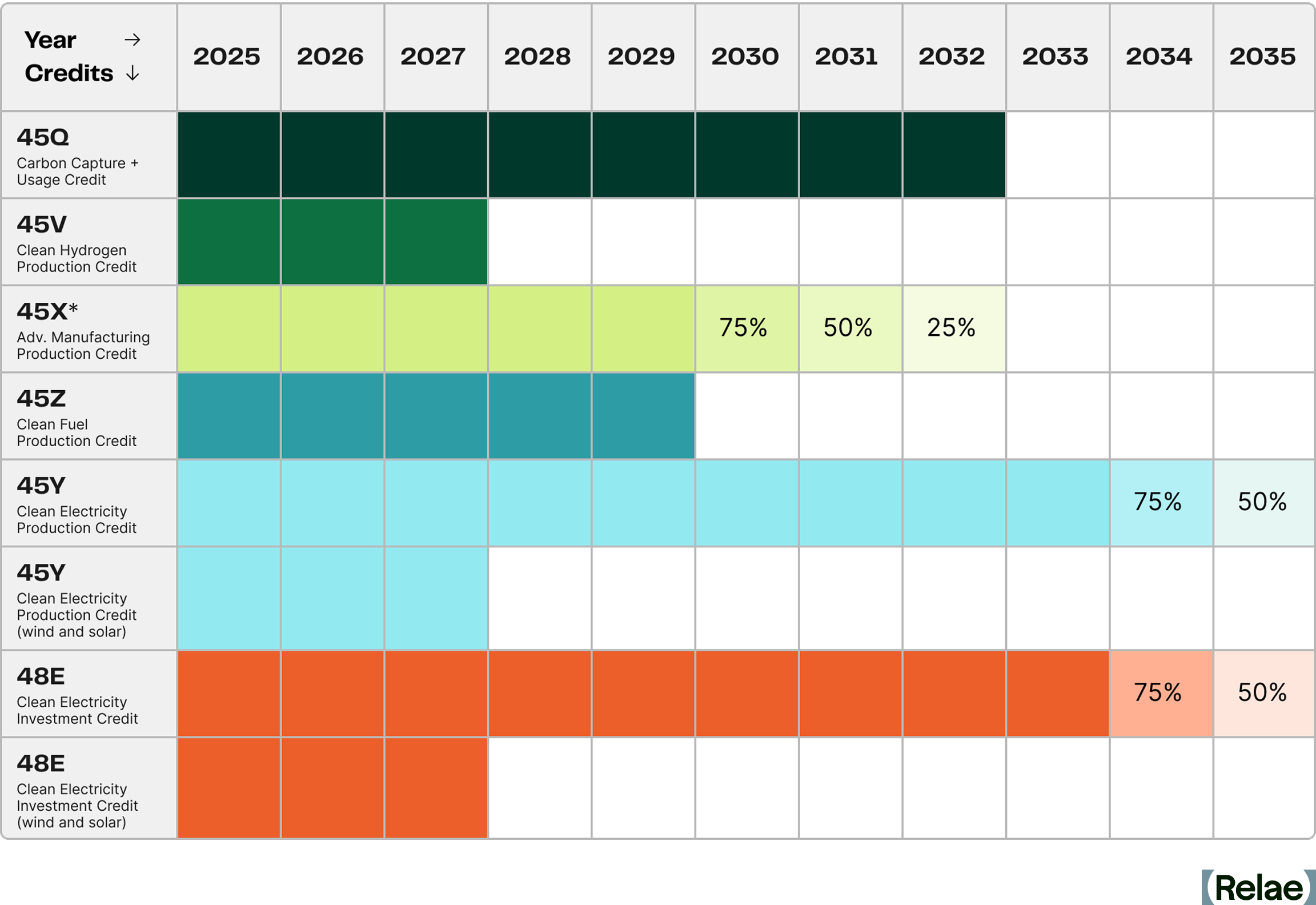
Many of the incentives to deploy clean energy that were created or enhanced under the IRA will be phased out early or repealed altogether. Credits with accelerated phase-out schedules include the newly created 45Y clean electricity production tax credit, which will no longer support wind or solar projects after 2027, and the 45V credit for clean hydrogen production for which projects must now commence construction before Jan 1, 2028 (moved up from Jan 1, 2033).
Since the passage of the reconciliation package, there has been active litigation on several provisions, including an order from a federal district court to vacate IRS guidance that would have prohibited certain wind and solar projects from securing safe harbor. The table below provides a detailed breakdown of key changes to major tax credits between the original IRA, the draft that moved through Committees in the House, and the final text that was passed by the Senate and signed into law.
Major Tax Credit Changes in the Reconciliation Law
How FEOC Restrictions Threaten Clean Energy Supply Chains
Many clean energy tax credits include ambiguous language restricting projects connected to FEOC, complicating supply chains and creating new problems for developers of clean energy projects. The law also introduces a complex matrix of new definitions, such as "Prohibited Foreign Entities," which includes both "Specified Foreign Entities" and "Foreign-Influenced Entities."
The FEOC restrictions embedded in the reconciliation bill represent a seismic shift for clean energy developers. These new rules, designed to limit the influence of Covered Nations (China, Russia, North Korea, and Iran), will disqualify projects from receiving tax credits if they source components, minerals, or intellectual property from entities tied to these nations. In other instances, the partial ownership or investment of an entity with financial ties to a Prohibited Foreign Entity may also disqualify a project from qualifying for tax credits.
This FEOC language matters for developers and investors because of the resulting global supply chain disruptions, investment uncertainty, and compliance burdens. The clean energy sector is deeply reliant on global supply chains, especially for solar panels, batteries, and wind components, industries where China currently dominates. The IRA intended to counter this by moving the manufacturing and production of these supply chains to the US. Project developers must now thoroughly review their supply chains and capital providers, and may need to quickly pivot to compliant resources.
In February 2026, the IRS released interim guidance on the FEOC provisions to provide safe harbor guidance for clean energy manufacturing, investment, and production credits to help taxpayers gauge whether material assistance was provided by a prohibited foreign entity.
Other Major Rollbacks to the IRA
Beyond clean energy tax credits, the reconciliation package also repeals and rescinds many other IRA provisions. This includes a full rescission of all unobligated IRA appropriated balances at the Department of Energy's Loan Programs Office, and several other programs, including:
- The Tribal Energy Loan Guarantee Program
- Greenhouse Gas Reduction Fund
- Transmission Facility Financing
A complete list of rescissions of energy-related funding is outlined in Sections 60001-60024 and 50402 of the law. These rescissions represent tens of billions of dollars in lost climate investments made under the IRA, which would have provided funds to state, local, and Tribal governments, federal agencies, non-profits, and commercial project developers to reduce emissions and update critical infrastructure.
What Can Project Developers and Other Companies Do?
Developers will need to act quickly to meet updated commence construction and place into service requirements, though circumstances are technology specific (e.g., safe harbor updates to 48E and 45Y). Tax credits generally have advanced commence construction and operational deadlines, resulting in a strong first-movers advantage. Companies should also review their supply chains and revise equipment and material procurement sourcing plans as necessary to address restrictions presented in the reconciliation bill.
An executive order from President Donald Trump issued on July 7 will further complicate how companies proceed. In the EO, the President directs his administration to "strictly enforce the termination of […] 45Y and 48E […] for wind and solar facilities." The Administration will likely issue extremely strict interpretations of "commence construction" clauses and FEOC requirements in forthcoming tax credit guidance issued by the Treasury Department, though these moves are quite likely to face litigation.
The new restrictions being proposed by the Administration, including specific details on FEOC, qualified equipment, commence construction, and other reporting requirements, will require additional guidance from the IRS and provide an opportunity for engagement through public comment. It is important that impacted companies weigh in during these public comment periods, not only to help inform and influence the final rules issued by the Administration, but also to build an administrative record that could support litigation efforts to strike down the final rules.
Staying Ahead of Policy Changes
Given the rapidly shifting landscape of energy policy, it's paramount that companies stay abreast of the latest changes and dedicate resources to understanding how they may be affected. Policy professionals, including the experts at Relae (formerly Carbon Direct), can support organizations as they engage in the regulatory process, anticipate and prepare for new legislation, and navigate the requirements to access essential tax credits and incentives. Even under new constraints, expert guidance can help maximize impact and minimize disruption.
Frequently Asked Questions
How does the reconciliation bill change the timelines for major clean energy tax credits?
Most clean energy tax credits saw their windows shortened relative to the original IRA:
- The 45Y and 48E credits now terminate entirely for wind and solar facilities placed in service after December 31, 2027, with a separate phase-down (75% in 2034, 50% in 2035, 0% after) for other technologies.
- The 45V clean hydrogen credit's "commence construction" deadline moved from December 31, 2032 to December 31, 2027.
- The 45Z clean fuel credit now ends on December 31, 2029 (versus 2027 in the original IRA, but bonuses for SAF have been removed and new emissions-calculation methods favor corn ethanol).
- Notably, the 45Q carbon capture credit saw little change and retained transferability, with credit values for enhanced oil recovery and utilization raised to match secure geological storage.
What are the FEOC restrictions, and why do they matter so much for developers?
FEOC ("Foreign Entity of Concern") restrictions disqualify projects from tax credits if they source components, minerals, or intellectual property from entities tied to China, Russia, North Korea, or Iran. Even partial ownership or investment ties to a "Prohibited Foreign Entity" can trigger disqualification. The definitions are complex and still being clarified through IRS guidance, meaning developers need to review supply chains and capital providers carefully and may need to pivot to compliant sourcing.
What should project developers do now in response to these changes?
Developers should move quickly to meet the earlier "commence construction" and "placed in service" deadlines, since credits now benefit early actors. This includes reviewing and potentially restructuring supply chains and procurement plans to address FEOC restrictions, and closely monitoring forthcoming IRS/Treasury guidance.